Visual overview
Beam loading, internal forces, and bending stress
Start with the question
Which formula do you need?
Find the internal bending moment from equilibrium first. Then calculate the section property for the correct axis and use it to find the extreme-fiber stress.
How does the section resist this bending?
Use the centroidal area moment for the bending axis in your diagram. For a rectangle, the section depth perpendicular to that axis is cubed.
You need: Width b and depth h, both expressed in consistent length units.
Open formula & calculatorWhat is the section modulus?
Divide the area moment by the distance to the extreme fiber. This packages the section geometry for an elastic stress check.
You need: Area moment I and extreme-fiber distance c for the same axis.
Open formula & calculatorWhat stress does the bending moment produce?
Use the largest relevant internal moment at the section. Mc/I and M/S give the same extreme-fiber stress magnitude; the sign convention tells you which side is in tension.
You need: Internal moment M, area moment I, and extreme-fiber distance c.
Open formula & calculatorCheck the model first
Before you start: Free-body diagrams, force and moment equilibrium, and consistent units.
- A slender, prismatic beam with small strains and deflections, made from a homogeneous, linearly elastic material.
- Bending about the stated centroidal principal axis. The rectangular-section formula assumes a solid rectangle.
- Nominal bending stresses away from local support, point-load, and notch disturbances. Shear, buckling, fatigue, and deflection need separate checks.
Put it together
From a central load to bending stress
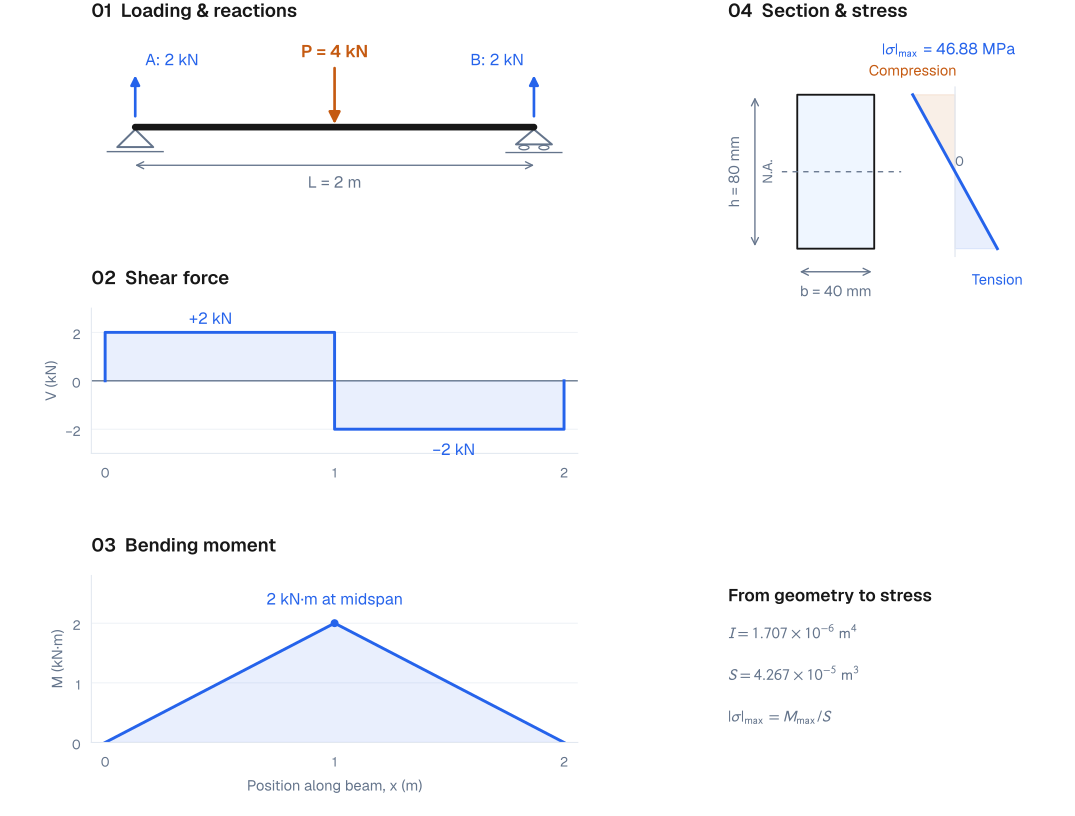
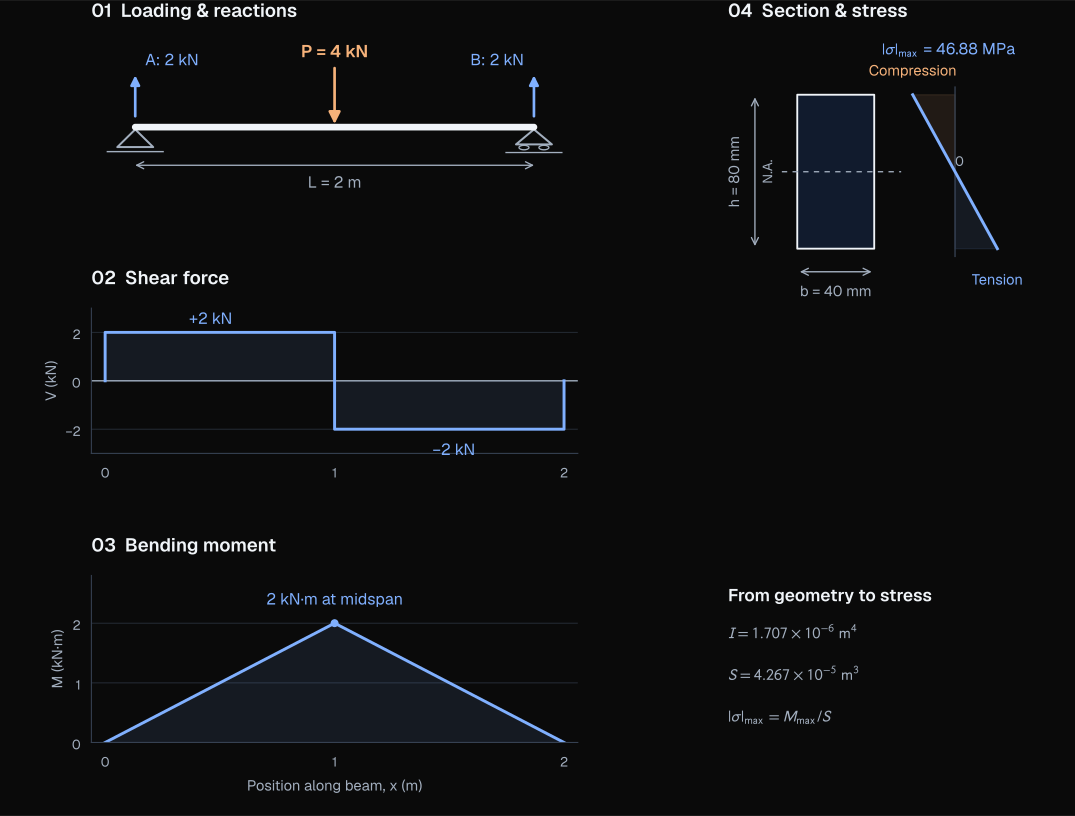
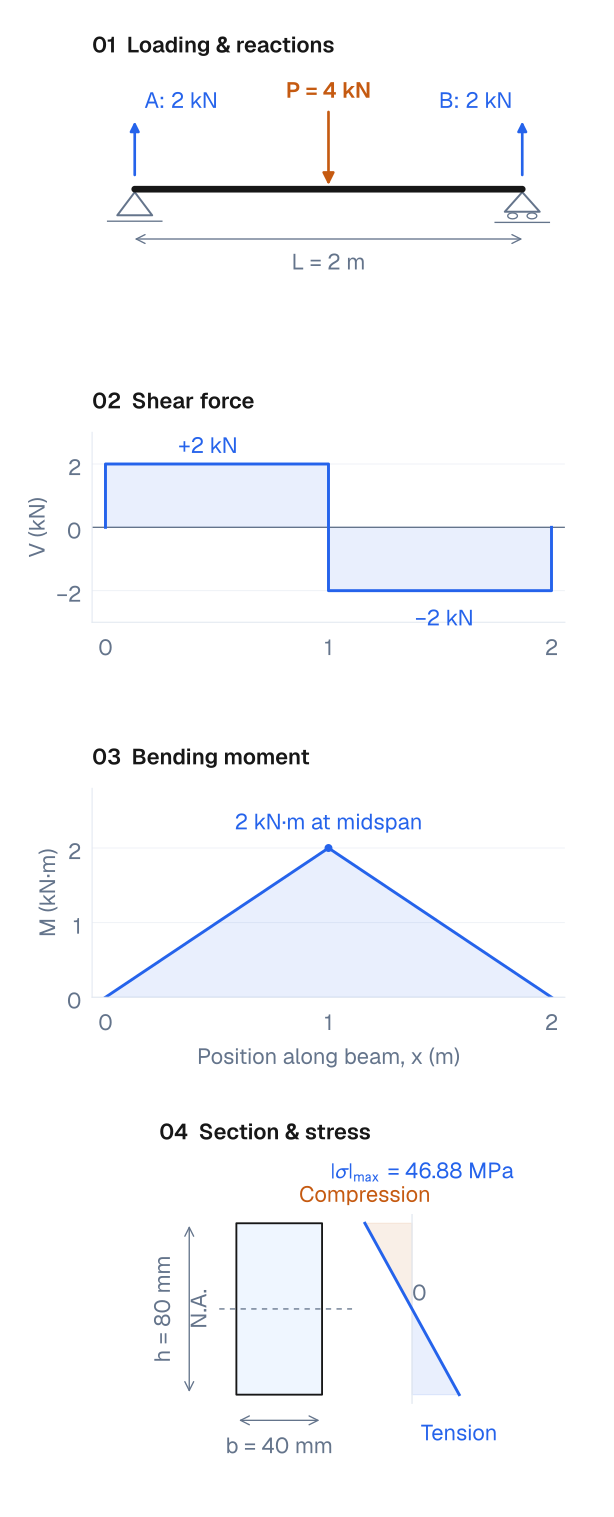
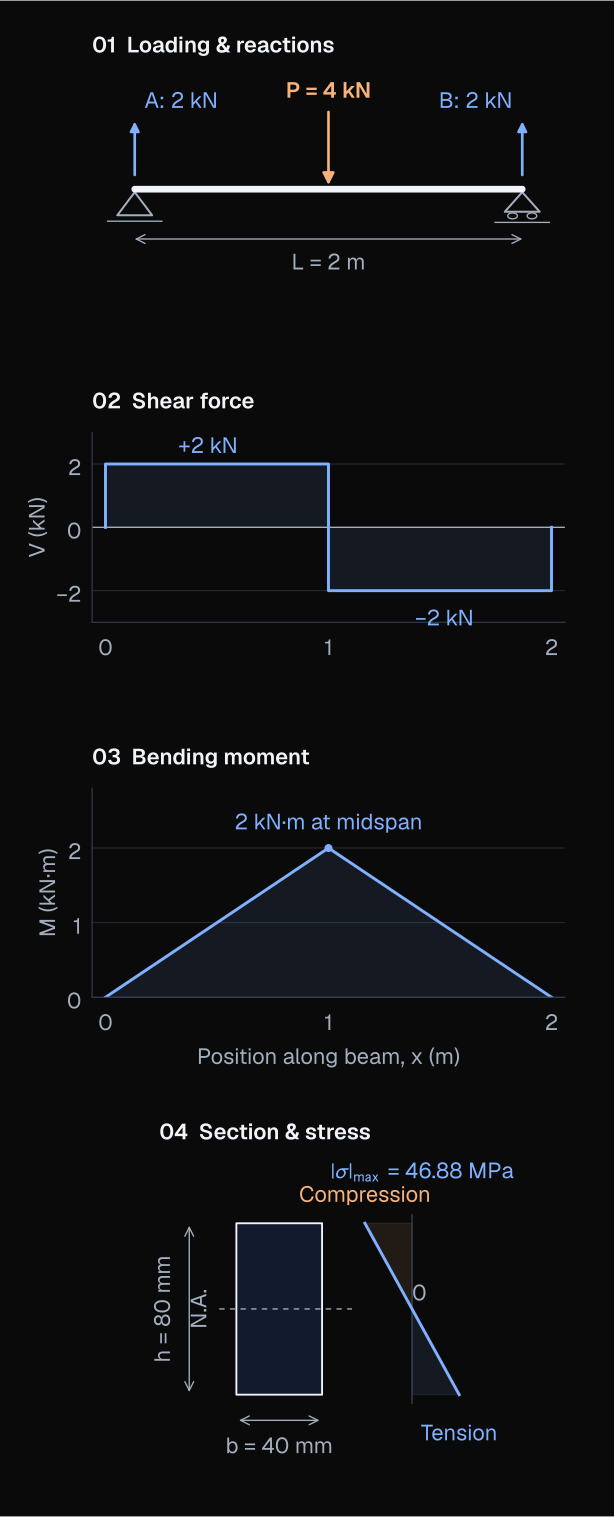
A simply supported beam spans 2 m and carries a 4 kN downward point load at midspan. Its solid rectangular section is 40 mm wide and 80 mm deep. Find the maximum elastic bending-stress magnitude for this orientation. Neglect self-weight.
First find reactions and the critical moment
Symmetry and vertical equilibrium give an upward reaction of 2 kN at each support. The moment increases to midspan, then decreases to zero at the other support. Use the peak value in the stress calculation.
01Calculate the area moment for this orientation
Use 80 mm as the section depth. Convert to meters before cubing it, so I comes out in m⁴.
Try your own values02Find the elastic section modulus
The neutral axis is at mid-depth, so the top and bottom fibers are both 0.040 m from it. Carry the full-precision I forward.
Try your own values03Use the peak moment to calculate stress
For positive sagging bending in this example, the top surface is in compression and the bottom is in tension. The equation below gives their equal magnitudes.
Try your own values
The maximum nominal bending stress is about 46.88 MPa. Compare it with the appropriate allowable stress, and check deflection and other failure modes separately. A stress result alone does not establish that this beam is acceptable.
Small mistakes that change the answer
Using force in place of moment
A 4 kN force is not a 4 kN·m moment. Solve reactions, cut the beam, and find the internal moment at the section you are checking.
Cubing the wrong dimension
The depth perpendicular to the bending axis is cubed in I = bh³/12. Rotating a rectangular section changes its resistance to bending.
Mixing length scales
If M is in N·mm, I in mm⁴, and c in mm, the stress is N/mm² = MPa. If you use N·m and meters throughout, stress is in Pa.
Treating a strength check as a stiffness check
A beam can have modest stress and still deflect too much. Deflection depends on the loading, supports, span, and flexural rigidity EI.
What changes for a built-up section?
Locate the area centroid, then add each component's centroidal area moment and its parallel-axis contribution. Use signed contributions for holes, and find the extreme-fiber distances relative to the assembled section's neutral axis.
This geometric sum alone is not a transformed-section method for bonded materials with different elastic moduli. Unsymmetric bending can also require a different formulation.
Check your understandingFor this rectangular beam, what happens to bending stress if you double the section depth while keeping width and loading the same?
I increases by 2³ = 8, while the extreme-fiber distance c doubles. Since stress is Mc/I, it becomes 2/8 = 1/4 of the original value. This comparison assumes the same internal moment and elastic model.