Visual overview
One heat flow, two temperature drops
Start with the question
Which formula do you need?
Identify the two endpoints for each heat-transfer mechanism. Conduction uses the wall-face temperatures; convection uses the surface and bulk-fluid temperatures. Divide a heat rate by area only when you need flux.
How much heat passes through the wall?
Use the wall's conductivity, area, and thickness with the temperature difference between its two faces. The formula gives a heat-transfer rate in watts.
You need: Thermal conductivity k, area A, thickness d, and wall-face temperature difference ΔT.
Open formula & calculatorHow much heat leaves the surface for the fluid?
Use the exposed surface temperature and the bulk-fluid temperature. The coefficient h summarizes this fluid-flow heat-transfer situation; it is not the wall's conductivity.
You need: Convection coefficient h, exposed area A, surface temperature Tₛ, and bulk-fluid temperature T∞.
Open formula & calculatorWhat is the heat rate per unit area?
Divide the heat-transfer rate by the corresponding area. For nonuniform transfer, this is an area average. Heat flux has units of W/m² rather than W.
You need: Heat-transfer rate and the area through which that rate passes.
Open formula & calculatorCheck the model first
Before you start: Temperature differences, basic algebra, and SI units.
- Steady, one-dimensional conduction through a plane wall with constant thermal conductivity and uniform cross-sectional area.
- No internal heat generation, contact resistance, side losses, or radiation in this example. With no energy storage, the series heat rate is the same through the wall and at the surface.
- A convection coefficient appropriate to the actual fluid and flow, and representative surface and bulk-fluid temperatures.
Put it together
Two mechanisms. One steady heat flow.
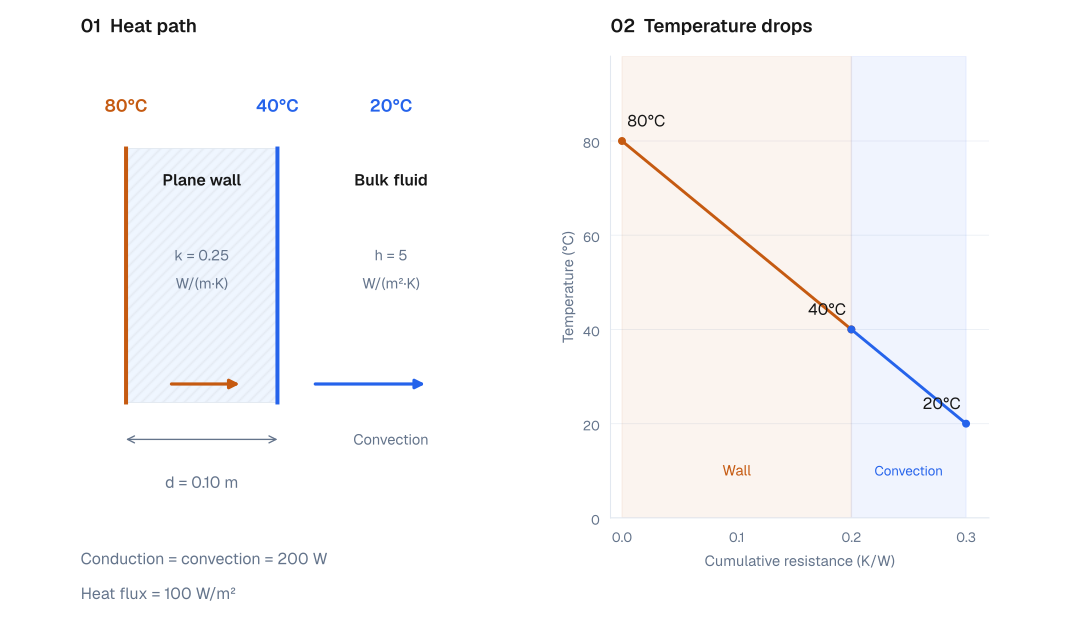
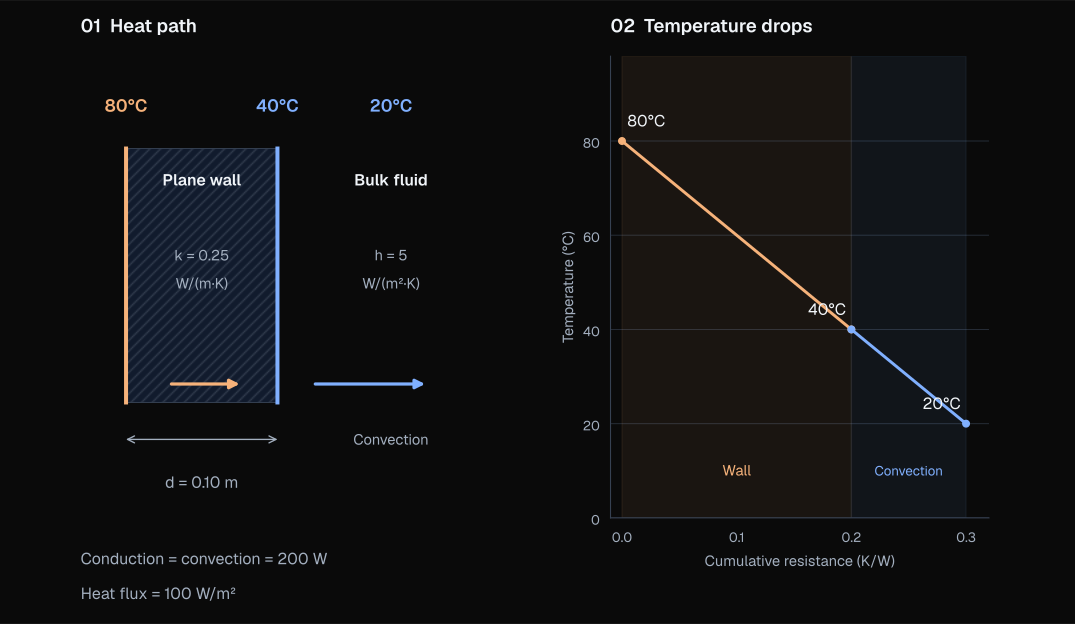
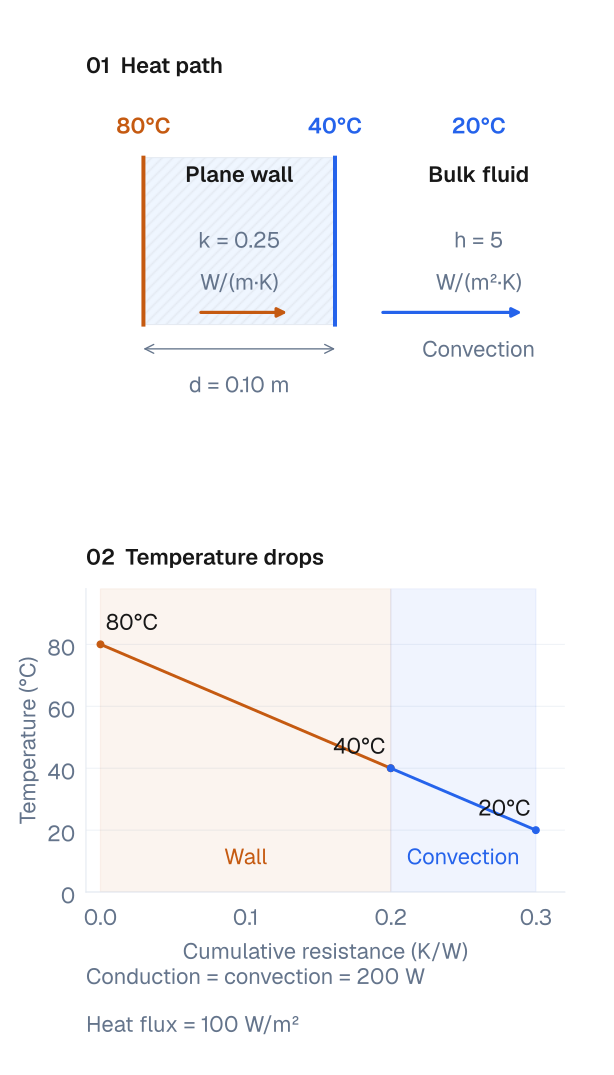
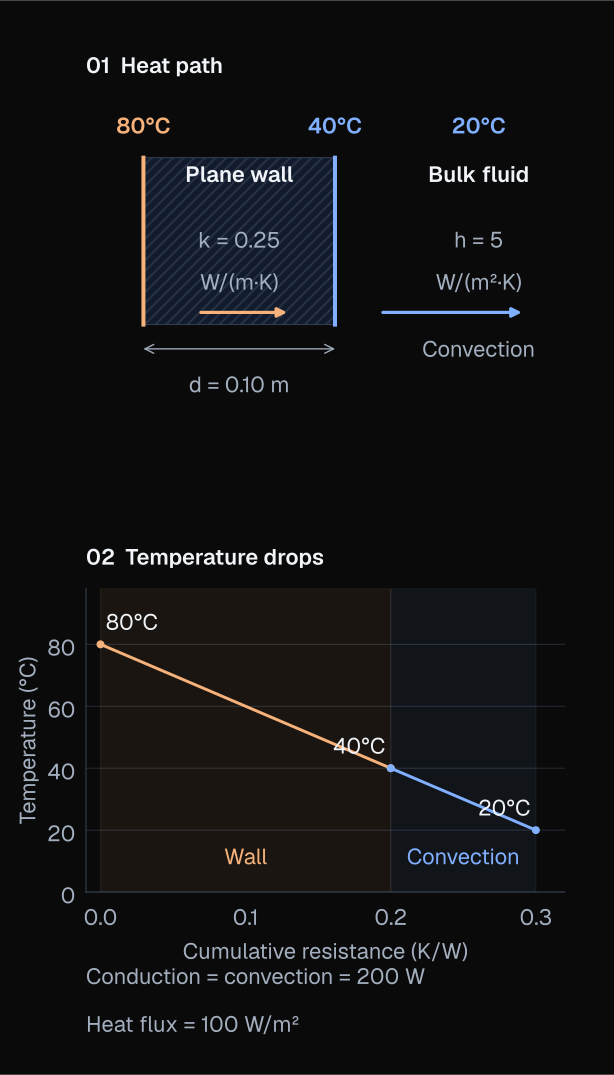
A plane wall has area 2 m², thickness 0.10 m, and thermal conductivity 0.25 W/(m·K). Its hot face is at 80°C and its exposed face at 40°C. Fluid at 20°C contacts that face with h = 5 W/(m²·K). Calculate the two heat rates and the heat flux; check whether they are consistent with steady operation.
01Apply the wall-face temperature difference
For conduction, use 80 − 40 = 40 K across the wall. A Celsius temperature difference has the same numerical value as a kelvin difference.
Try your own values02Use surface-to-fluid temperatures for convection
The convection temperature difference is 40 − 20 = 20 K. The matching rate means that these boundary values satisfy the steady energy balance for the stated model.
Try your own values03Convert the rate into an average flux
Divide either rate by the same 2 m² area. Choose positive heat flow from the hot face toward the cooler fluid.
Try your own values
Both mechanisms transfer 200 W, so the heat flux is 100 W/m². Do not add the two rates: they describe the same heat flowing through successive parts of this steady, one-dimensional system.
Small mistakes that change the answer
Using one temperature difference everywhere
The wall sees 80 − 40 K; convection sees 40 − 20 K. The full 80 − 20 K difference spans both mechanisms and requires their combined thermal resistance.
Confusing k with h
Thermal conductivity k has units W/(m·K). The convection coefficient h has units W/(m²·K) and depends on the fluid and flow configuration.
Adding series heat rates
With no energy storage, generation, or side losses, the same heat rate passes through each series element. A mismatch means the stated steady model or boundary values need checking.
Confusing heat rate with heat flux
Watts measure total heat-transfer rate. Watts per square meter measure flux. Dividing by an unrelated surface area gives the wrong physical quantity.
What if the surface temperature is unknown?
For this one-wall, one-convection model, add the wall and convection thermal resistances. Use the hot-face-to-bulk-fluid temperature difference to get the common rate, then recover the surface temperature from either element's drop.
These are whole-element resistances in K/W. Additional surfaces, contacts, radiation, or parallel heat paths must be modeled explicitly. The plotted horizontal coordinate is cumulative resistance, not distance in the fluid.
Check your understandingIf the wall thickness doubles while its two face temperatures, area, and conductivity stay fixed, what happens to its conductive heat rate?
The conductive rate halves because it is inversely proportional to thickness. If instead only the hot-face and bulk-fluid temperatures stay fixed, the surface temperature changes too: recompute the combined wall and convection resistances rather than assuming that the overall rate halves.